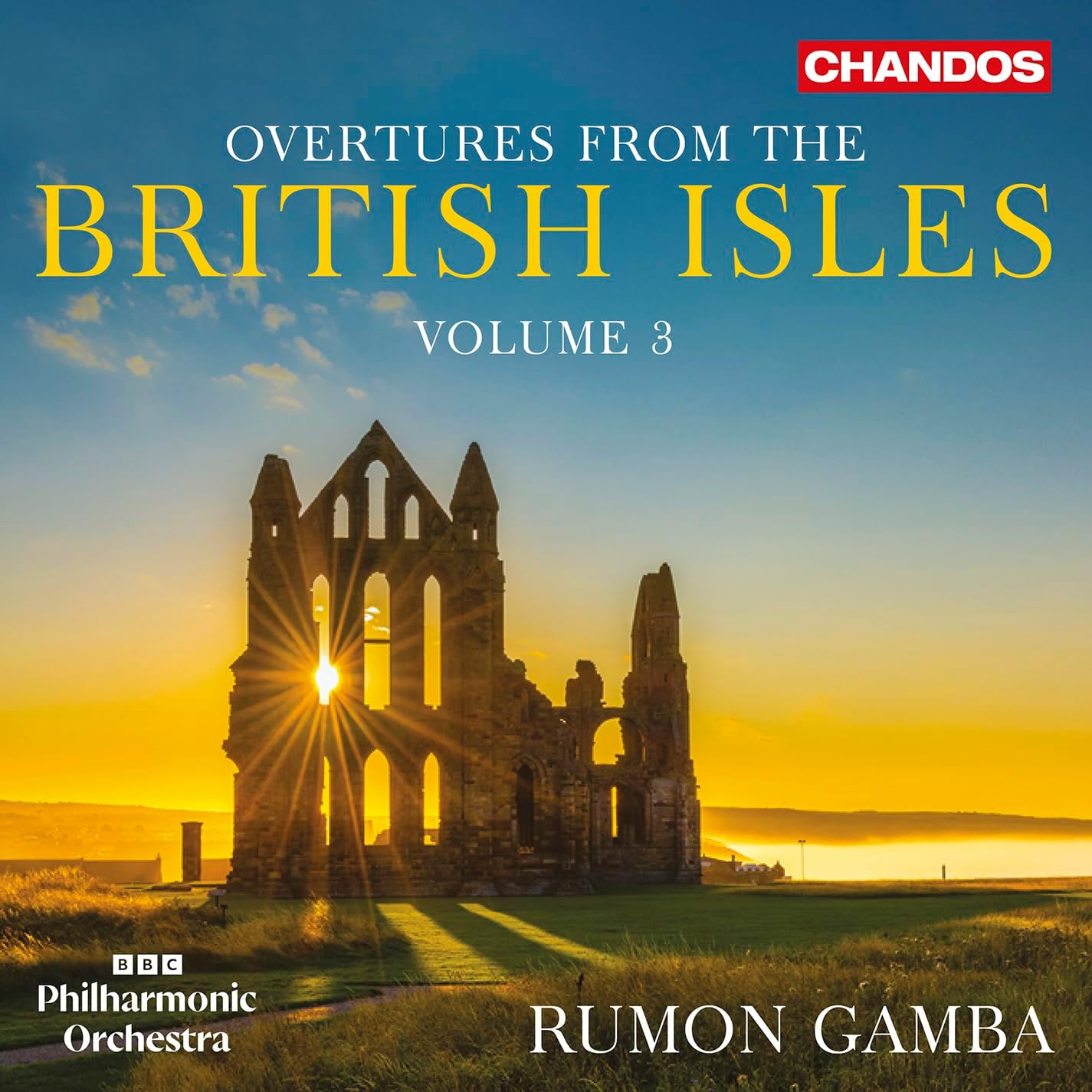
BBC Philharmonic
Conductor: Rumon Gamba
Chandos
This somewhat unexpected third release in the Chandos British Overtures series (it is several years since volume 2) is a celebration of the diversity of British music in the 20th Century. A number of light works make up the bulk of this disc’s running time, so there will be much here to delight the Light Music lover as well, to say nothing of a number of pieces that would suit many a light orchestral concert.
Havergal Brian is not a composer I always associate with music of a lighter sort, but his overture The Tinker’s Wedding that opens the disc is a charming surprise. The sudden mood changes that are something of a stock-in-trade for this composer are here amplified to comic effect, lurching from one jaunty theme to another, with some gentler relief in between. It is a far cry from the rapid-fire arguments of his 32 symphonies but shows the composer at his most jocular and is none the worse for it! The orchestra proves itself more than up to the challenge of the virtuosic twists and turns of this work.
Geoffrey Bush’s Yorick overture was written in memory of the comic actor Tommy Handley and perfectly captures an overall sense of joie de vivre, though there is a mournful (and very beautiful) central passage, perhaps lamenting the loss of the actor, or hinting at sorrow behind the bon vivant exterior.
I expected something of a more fraught musical landscape from Alan Rawsthorne but was pleasantly surprised by the tuneful playfulness of Street Corner (melodically pleasing, more than hummable perhaps), and was similarly surprised by Daniel Jones’ Comedy Overture. This is a truly lighthearted work from a composer I’ve occasionally found considerably
Rebus was the final completed orchestral work of composer Frank Bridge, whose style underwent something of a mid- career sea change, from sweeping romantic works such as Enter Spring and The Sea to jagged and hard-edged (for then) modernity. Rebus is a challenging work to play (though the BBC Philharmonic are easily up to the task!), but not as tough, nor as doom-laden as his earlier Phantasm or Oration. It has dark corners, certainly, but seems to be more of an attempt to create a fusion of his earlier and later idioms. Prepare to be swept away by Straussian romanticism at the work’s climax.
Robin Orr’s The Prospect of Whitby does not refer to the coastal town, but actually to a tavern near Execution Dock in London. Like Rawsthorne, Orr conjures a brilliantly vibrant evocation of the city, though the darker central passage perhaps suggests the troubled past of the area. Similarly shadowy is Richard Arnell’s The New Age overture, though I did feel on balance that Martin Yates’ Dutton recording conveyed a slightly greater sense of unease and urgency in the work.
Curiously, most of the works here were written for the concert platform and not the stage, with the exception being Britten’s Paul Bunyan overture, played here in an arrangement for full orchestra by Colin Matthews. The BBC Phil make the most of Matthews’ more expansive textures, lending the overture a sense of spaciousness not always found in its original incarnation. Alan Bush’s Resolution appears also in an orchestral expansion, having been written first for band. It is possibly the most astringent work harmonically, heavy on influences from the social realist influences from Russia, which also influenced the composer’s own politics and adversely impacted his career. The orchestra and Gamba make a convincing case for the work as a fine piece of music, however, when taken on its own merit without the political baggage surrounding it.
The CD concludes on a decidedly lighter note. First, we have Clifton Parker’s brief The Glass Slipper overture (written for a stage play). The overture was written for a Cinderella adaptation at the St. James Theatre in 1944 and I’m sure will have proved a wonderful curtain-raiser with its deft melding of accessibly modern harmonies in a neoclassical vein. Finally, we have the fantastically witty and indeed skilful Rossini on Ilkla Moor composed by Delius’ amanuensis Eric Fenby. As the title suggests, the overture takes the famed folk tune and proceeds to treat it as if it were an opera overture by its eponymous composer. It seems Fenby let very few of his own compositions survive, but of the surviving handful, this appears to be the only orchestral work. The orchestra are clearly having fun with this and indeed all the works on the disc and I’m sure so will you! DA
Leave a Comment
I hope you enjoyed this post. If you would like to, please leave a comment below.